Sections
  • News & Politics
    • Washingtonian Today
  • Things to Do
    • DC Welcome Guide
    • This Week
    • 100 Best Things to Do in DC
    • Neighborhood Guides
    • DC-Area Events Calender
    • Washingtonian Events
  • Food & Drink
    • 100 Very Best Restaurants
    • The Hot List
    • Brunch
    • New Restaurants
    • Restaurant Finder
  • Home & Style
    • Health
    • Parenting
  • Shopping
    • Gift Guides
  • Real Estate
    • Top Realtors
    • Listings We Love
    • Rave Worthy Rentals
  • Weddings
    • Real Weddings
    • Wedding Vendor Finder
    • Submit Your Wedding
  • Travel
    • DC Welcome Guide
    • Best Airbnbs Around DC
    • 3 Days in DC
  • Best of DC
    • Doctors
    • Apartment Rentals
    • Dentists
    • Financial Advisors
    • Industry Leaders
    • Lawyers
    • Mortgage Pros
    • Pet Care
    • Private Schools
    • Realtors
    • Wedding Vendors
  • Magazine
    • Subscribe
    • The 1965 Club
    • Manage Subscription
    • Current & Past Issues
    • Features and Longreads
    • Newsletters
    • Newsstand Locations
Reader Favorites
  • 100 Very Best Restaurants
  • DC-Area Events Calendar
  • Brunch
  • Neighborhoods
  • Newsletters
  • Directories
  • Washingtonian Events
Washington’s Best
  • Apartment Rentals
  • DC Travel Guide
  • Dentists
  • Doctors
  • Financial Advisers
  • Health Experts
  • Home Improvement Experts
  • Industry Leaders
  • Lawyers
  • Mortgage Professionals
  • Pet Care
  • Private Schools
  • Real Estate Agents
  • Restaurants
  • Retirement Communities
  • Wedding Vendors
Privacy Policy |  Rss
© 2026 Washingtonian Media Inc.
All Rights Reserved
Skip to content
Washingtonian.com
  • Search
  • Subscribe
  • Menu
Washingtonian.com
  • Subscribe
Reader Favorites
  • 100 Very Best Restaurants
  • DC-Area Events Calendar
  • Brunch
  • Neighborhoods
  • Newsletters
  • Directories
  • Washingtonian Events
More
  • Subscribe
  • Manage My Subscription
  • Digital Edition
  • Shop
  • Contests
  • About Us
  • Advertising
  • Contact Us
  • Jobs
Sections
  • News & Politics
  • Food
  • Things to Do
  • Washingtonian Events
  • Home & Style
  • Editors’ Picks
  • Events Calendar
  • Health
  • Longreads
  • Parenting
  • Real Estate
  • Shopping
  • Travel
  • Weddings
  • News & Politics
    • Washingtonian Today
  • Things to Do
    • DC Welcome Guide
    • This Week
    • 100 Best Things to Do in DC
    • Neighborhood Guides
    • DC-Area Events Calender
    • Washingtonian Events
  • Food & Drink
    • 100 Very Best Restaurants
    • The Hot List
    • Brunch
    • New Restaurants
    • Restaurant Finder
  • Home & Style
    • Health
    • Parenting
  • Shopping
    • Gift Guides
  • Real Estate
    • Top Realtors
    • Listings We Love
    • Rave Worthy Rentals
  • Weddings
    • Real Weddings
    • Wedding Vendor Finder
    • Submit Your Wedding
  • Travel
    • DC Welcome Guide
    • Best Airbnbs Around DC
    • 3 Days in DC
  • Best of DC
    • Doctors
    • Apartment Rentals
    • Dentists
    • Financial Advisors
    • Industry Leaders
    • Lawyers
    • Mortgage Pros
    • Pet Care
    • Private Schools
    • Realtors
    • Wedding Vendors
  • Magazine
    • Subscribe
    • The 1965 Club
    • Manage Subscription
    • Current & Past Issues
    • Features and Longreads
    • Newsletters
    • Newsstand Locations
News & Politics

Virginia Wants To Become the Center of the Cyber-Security Universe

Finding new ways to thwart digital bad guys.

Written by Amanda Whiting
| Published on May 14, 2018
Tweet Share
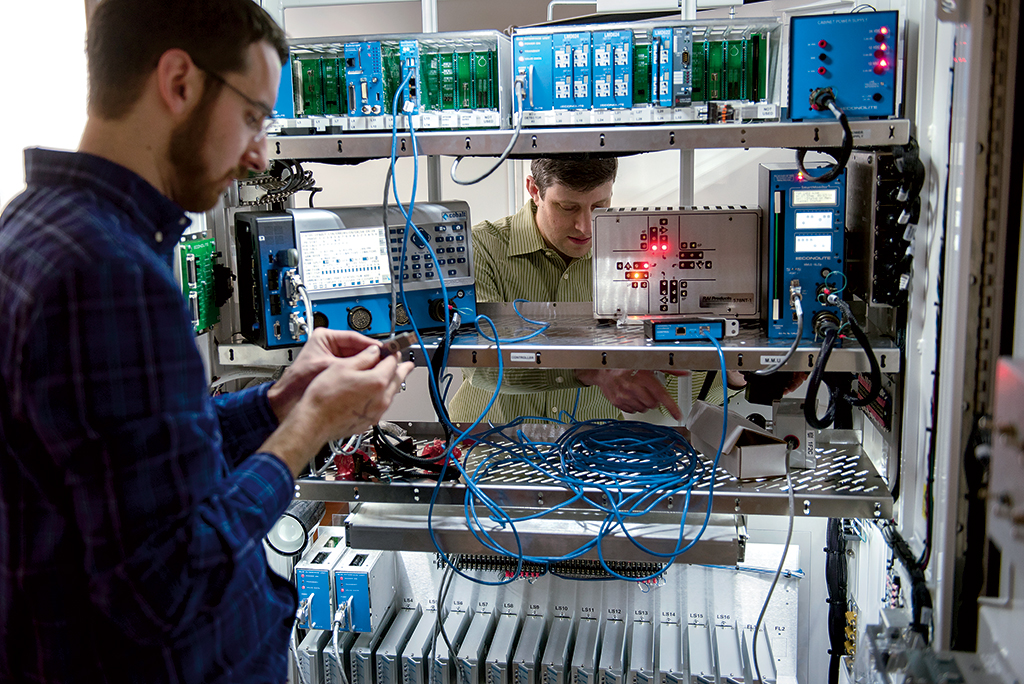
At Virginia Tech’s Ballston campus, students try to thwart bad guys by thinking like them. Photograph courtesy of Logan Wallace/Virginia Tech.

On an episode of Mr. Robot, the good guy hacks into a data-storage plant’s HVAC system and raises the temperature enough to start a fire. He does it by attaching a credit-card-size computer called a Raspberry Pi, which is a real thing that exists outside of TV, to the facility’s thermostat system. This may seem like something a bad guy would do, but the world of cybersecurity—and, frankly, the show—can be confusing.

And if you think it sounds far-fetched, you should see what researchers are working on at the Hume Center for National Security and Technology, on Virginia Tech’s Ballston campus.

“The perspective we’re taking is that you can’t build a perfectly secure system—it will be compromised at some point,” says professor Ryan Gerdes, tucking his chin-length wavy hair behind his ears amid a maze of projects in the Cyber-Physical System Security lab. The windowless facility—no bigger than an average bedroom—is crowded with screens, wires, and servers, plus more expensive stuff such as 77-GHz automotive radars (the kind that can detect collisions), waveform generators, and oscilloscopes that add up to $400,000.

Gerdes points to a thin line moving across a small display, similar to an EKG reading. It’s attached to a computer the size of a SIM card, which is mimicking the inside of a car. Gerdes and his students are trying to invent a method of detecting a “compromise” in a self-driving car, much as antivirus software does for your laptop. Another student is exploring how to bring down a drone in a “coordinated” way if it violates airspace restrictions—i.e., land it rather than shoot it out of the sky. “It sounds like a Bond-villain weapon,” says Hume Center director Charles Clancy, but it’s for the purpose of good: hacking the drone the same way a bad guy might hack a car. A third student is investigating how a smart building might resist Mr. Robot’s HVAC attack.

These are the kinds of projects that some Virginia lawmakers are hoping to expand with the funding of CyberX, an initiative aiming to increase higher-ed opportunities in the state and, eventually, fill some of the 42,000 open cybersecurity jobs in the Washington area.

In January, Virginia House delegate Chris Jones invited Virginia Tech president Timothy Sands to propose a “cyber moon shot.” The president told Jones the university was already on it, developing a network of faculty entrepreneurs through the center’s research. The faculty-led start-up Federated Wireless, for example, completed its B round of funding last year, bringing in $76 million in venture capital, with grad students going on to be employees. While that was one of eight start-ups to come out of Hume in its eight-year existence, Sands thought it would be terrific if it could scale up faster and team with other Virginia universities to bring in more industry partners.

Jones asked Sands to rough out a concept paper—“the first all-nighter I’ve pulled since college,” says Sands. A few weeks later, CyberX appeared as a $50-million line item in the Virginia House’s proposed budget. Ten million would be set aside for establishing a cutting-edge shop in Northern Virginia; another $15 million would go toward hiring research faculty, building entrepreneurship programs, and developing educational programming at the new hub.

Focusing on developing technologies that have a natural pipeline to the local market is an idea that DC innovation consultant and investor Jonathan Aberman agrees is smart. “What’s not appreciated is that technologies like Siri, videoconferencing, and GPS largely happened because of scientists and agencies located in the DC region,” Aberman says. “Most of the technology that makes your cell phone useful wouldn’t exist today. Let other regions create ‘Facebook for Cats’—we should be leading the nation in cybersecurity, biohealth, and advanced software.”

Clancy says that cyber is one of the areas in which public- and private-sector interests are aligned. A technology that begins as a Navy contract, for example, could go on to broader commercial success.

Says Sands: “What you used to think of as a cyber problem—like getting your e-mailed hacked and the data dumps of private info being made accessible—is still important, but the issues have grown to the point where we’re talking about the whole of the country’s physical infrastructure being at risk.”

If the state doesn’t fund CyberX, Sands says, Virginia Tech still plans to pursue the initiative, though more slowly and with additional private partners. The state-funded cybersecurity accelerator Mach37 and Virginia Tech’s well-regarded online master’s degree in information tech—ranked number two by U.S. News & World Report—have already put Virginia on the map, but Sands says that’s just a start: “We want Virginia to be the center of the universe when it comes to cyber.”

This article appeared in the May 2018 issue of Washingtonian.

More: CybersecurityNavyNorthern VirginiatechnologyVirginia Tech
Join the conversation!
Share Tweet
Amanda Whiting
Contributing Editor

Amanda has contributed to Washingtonian since 2016. She has written about the right-wing media personality Britt McHenry, chronicled her night with Stormy Daniels, and come clean about owning too much stuff. She lives on H Street. She can be reached at [email protected].

Most Popular in News & Politics

1
SLF-spotted lanternfly (Lycorma delicatula) adult winged, in Pennsylvania, on July 20, 2018.

See a Spotted Lanternfly? Here’s What to Do.

2

Meet DC’s 2025 Tech Titans

3

What Happens After We Die? These UVA Researchers Are Investigating It.

4

GOP Candidate Quits Virginia Race After Losing Federal Contracting Job, Trump Plans Crackdown on Left Following Kirk’s Death, and Theatre Week Starts Thursday

5

USDA Spent $16,400 on Banners to Honor Trump and Lincoln

Washingtonian Magazine

September Issue: Style Setters

September Issue: Style Setters

View Issue
Subscribe

Follow Us on Social

We'll help you live your best #DCLIFE every day

Follow Us on Social

We'll help you live your best #DCLIFE every day

Related

How Howard University Is Helping Tech Understand Black Speech

Meet the DC Tech CEO With a Flip Phone and No Social Media

Chris Hayes Knows Why Tech Makes Us Feel Bad

Inside the Library of Congress’s Artificial-Aging Lab

More from News & Politics

How to Pick a Good Title-and-Settlement Company in the DC Area

Weird Press Conference Ends Trump’s Vacation From Offering Medical Advice, Kimmel Goes Back to Work Tonight, and DC Man Arrested for Shining Laser Pointer at Marine One

Why Can You Swim in the Seine but Not the Potomac River?

Nominations Are Now Open for 500 Most Influential People List

Trump and Musk Reunite, Administration Will Claim Link Between Tylenol and Autism, and Foo Fighters Play Surprise Show in DC

This DC Woman Might Owe You Money

A New Exhibition Near the White House Takes a High-Tech Approach to a Fundamental Question: What Is the American Dream?

Want to See What Could Be Ovechkin’s Last Game in DC? It’s Going to Cost You.

© 2026 Washingtonian Media Inc.
All Rights Reserved.
Washingtonian is a participant in the Amazon Services LLC Associates Program, an affiliate advertising program designed to provide a means for sites to earn advertising fees by advertising and linking to Amazon.com.
Privacy Policy and Opt-Out
 Rss
Get the best news, delivered weekly.
By signing up, you agree to our terms.
  • Subscribe
  • Manage My Subscription
  • Digital Edition
  • Shop
  • Contests
  • About Us
  • Advertising
  • Contact Us
  • Jobs